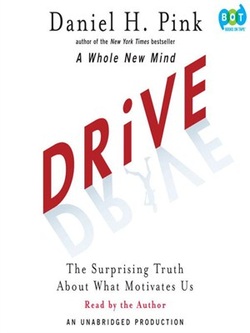
For my choice book, I have been reading or more so "listening" to Drive: The Surprising Truth About What Motivates Us by Daniel H. Pink. (I resorted to listening to the audiobook after I realized I was reading this book at a much slower pace than I wanted).
Pink begins the book by using the metaphor of motivation as that of an operating system. He tells readers that humans initial operating system, which he calls Motivation 1.0 was survival. Motivation 1.0 worked well, that was until society started to get more complex. Pink states an operating system based purely on the biological drive was inadequate. "In fact, sometimes we needed ways to restrain this drive -- to prevent me from swiping your dinner and you from stealing my spouse." (pg. 16). This is when humans replaced Motivation 1.0 with Motivation 2.0, the more current system we work and live in.
This second drive, Motivation 2.0, stated that humans set out to seek reward and avoid punishments. Motivation 2.0 is built entirely around rewards and punishments and what Pink refers to as "carrots and sticks". Motivation 2.0 is based of external forces; rewarding the behavior that one seeks and punishing the behavior that one discourages. Pink goes on to state that today we've configured our organizations and constructed our lives around the assumption, "The way to improve performance, increase productivity, and encourage excellence is to reward the good and punish the bad." Furthermore, Motivation 2.0 utilizes the system of "If-then" rewards, which pretty much states, "If you do this, then you'll get that." This system did extremely well and made huge achievements; but as much operating systems do, it calls for an upgrade.
This is where Motivation 3.0 comes into play. This operating system still keeps the same outlooks of Motivation 1.0 and Motivation 2.0 stating humans still have the behavioral drive for survival as well as the drive for reward and punishment; but it also states that humans have a drive to to direct their own lives. Pink goes on to state that Motivation 3.0 is the operating system we need to meet new realities of how we organize, think about, and do what we do. He says that this kind of operating system can only be fostered by what he calls "Type I behavior." Type I behavior is a behavior that concerns itself with more intrinsic desires and more with the inherent satisfaction of itself. Pink goes on to state that Type I behavior is more self-directed and devoted to becoming better and better at something. "For Type I's, the main motivator is freedom, challenge, and purpose of the undertaking itself; any other gains are welcome, but mainly as a bonus" (pg. 76). To end, Pink believes this drive is revolved around three elements: autonomy, mastery, and purpose, which I will discuss further in another post.
Question for thought:
Do you considered yourself to have Type I behavior? If not, what can you change in your lives to have more a Type I behavior?
Pink begins the book by using the metaphor of motivation as that of an operating system. He tells readers that humans initial operating system, which he calls Motivation 1.0 was survival. Motivation 1.0 worked well, that was until society started to get more complex. Pink states an operating system based purely on the biological drive was inadequate. "In fact, sometimes we needed ways to restrain this drive -- to prevent me from swiping your dinner and you from stealing my spouse." (pg. 16). This is when humans replaced Motivation 1.0 with Motivation 2.0, the more current system we work and live in.
This second drive, Motivation 2.0, stated that humans set out to seek reward and avoid punishments. Motivation 2.0 is built entirely around rewards and punishments and what Pink refers to as "carrots and sticks". Motivation 2.0 is based of external forces; rewarding the behavior that one seeks and punishing the behavior that one discourages. Pink goes on to state that today we've configured our organizations and constructed our lives around the assumption, "The way to improve performance, increase productivity, and encourage excellence is to reward the good and punish the bad." Furthermore, Motivation 2.0 utilizes the system of "If-then" rewards, which pretty much states, "If you do this, then you'll get that." This system did extremely well and made huge achievements; but as much operating systems do, it calls for an upgrade.
This is where Motivation 3.0 comes into play. This operating system still keeps the same outlooks of Motivation 1.0 and Motivation 2.0 stating humans still have the behavioral drive for survival as well as the drive for reward and punishment; but it also states that humans have a drive to to direct their own lives. Pink goes on to state that Motivation 3.0 is the operating system we need to meet new realities of how we organize, think about, and do what we do. He says that this kind of operating system can only be fostered by what he calls "Type I behavior." Type I behavior is a behavior that concerns itself with more intrinsic desires and more with the inherent satisfaction of itself. Pink goes on to state that Type I behavior is more self-directed and devoted to becoming better and better at something. "For Type I's, the main motivator is freedom, challenge, and purpose of the undertaking itself; any other gains are welcome, but mainly as a bonus" (pg. 76). To end, Pink believes this drive is revolved around three elements: autonomy, mastery, and purpose, which I will discuss further in another post.
Question for thought:
Do you considered yourself to have Type I behavior? If not, what can you change in your lives to have more a Type I behavior?
